Silent Film Music and other Sounding Off

Talking about music, consciousness, silent film, Italian food, travel, good books, married life, kids, and more

Saturday, May 09, 2009

Sonoma Film Festival, Turner Classic Movies, and more

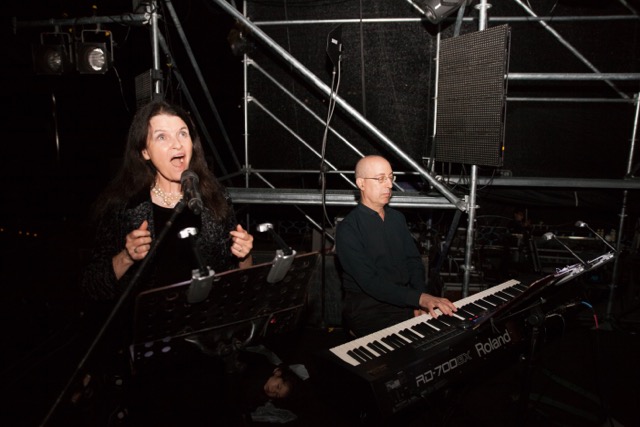
It's May, and I'm catching up on a whirlwind month of work. I went out to Sonoma California in early April for their annual film festival and played for ROBIN HOOD (1922) and THE PEACH GIRL (1931) with my new Roland RD-700GX. What a great festival! They honored Bruce Willis (didn't get to meet him) and showed a lot of new films by mostly young filmmakers. I particularly enjoyed 500 DAYS OF SUMMER, THE ANSWER MAN, PUNCHING THE CLOWN, BIG DICK, and THREE-FIFTY, and had fun talking with some of the filmmakers. For the Fairbanks film I programmed a variety of medieval sounds: trumpets, drums, recorders, lutes, as well as some more Hollywood-y strings for romance, and improvised on some themes I had prepared beforehand.

The DVD looked fine on a rear projection system, and the capacity audience of 200 gave the performance a standing ovation. The event was voted the #2 audience favorite, which was fantastic, particularly considering it was the first time a silent film had been shown there in the 12 years of the festival.

I also played for the lovely PEACH GIRL, which I had scored previously for Richie Meyer, and which has been shown on TCM. The festival staff is terrific and everyone hoped to do another silent program or two next year. I'm ready!

Having put the finishing touches on THE BIG STAKES, a 1921 Western, I sent it off to Dennis Doros at Milestone Films, and it was shown on TCM on May 5. Along with sounds from the Roland, I had the great pleasure of some help from Howard Levy, harmonica player extraordinaire, Susan Heerema, violin virtuoso, Joe Bouchard, mandolin and banjo whiz, and John Meyer, acoustic guitar genius. Howard and Susan sent in their tracks from Chicago and New Jersey, respectively, and I merged them with the work I and the others did in my home studio. You can hear some of the finished product on YouTube.

www.youtube.com/watch?v=o4h74gkOMPs

(I tried linking this but it's not working, so copy the whole link and paste...)

Late in April I met with Chris Farina, who directed a new documentary about John Hunter, a teacher of gifted children in Virginia. For 30 years John has been giving workshops to kids using the World Peace board game he developed, and the doc follows the progress of one 4th grade class from day 1 to game's end. Chris has chosen some pre-existing music for a few spots in the film, and I will be adding some additional tracks. The hour-long film is slated for showing on PBS in the fall.

I'm now in Fairfield, Iowa teaching a one-month music appreciation course at Maharishi University of Management. I have 16 students, diverse in age and ability, but all sharing a common love of many different kinds of musical expression, particularly singing, and our daily practice of the Transcendental Meditation technique.

The morning sessions consist of flute lessons taught by an Indian master, and piano lessons, with my guidance both in person and online through my course in Absolute Beginner Keyboard at workshoplive.com. Afternoons are spent singing a broad range of songs from Gregorian chant to Beatles, learning the blues, studying different styles of music, theory, songwriting, and how all this relates to our own consciousness. It's a thrill to be able to share all that I've learned with these lively beings, and the other faculty and administration I have met with are hoping that the music courses here will grow and expand in the coming year. Next week I'll lead a songwriting workshop with kids at the Maharishi School, 3rd to 6th grade, and use the songs they write for the performance of ROBIN HOOD the following week, in which I'll be joined by some of the students in my class on guitar, percussion, bass and keyboard. It's an exciting place to be and I hope to come back in the fall.

Labels: , , , , ,

Thursday, March 26, 2009

Since December I've been writing a weekly column for the Lakeville Journal in northwest CT. I was looking forward to writing about the Crescendo Chorus' tribute to Felix and Fanny Mendelssohn on Sunday afternoon at Trinity Church in Lime Rock but due to schedule conflicts, I only caught the second half, so the paper will not publish these comments. For the record...

What I did hear was a sublime hour of ravishingly beautiful vocal music, interspersed with readings of letters exchanged between brother and sister and some of their circle of friends and family. Both music and letters ranged from poignant to exuberant, with the highlight being Felix's setting of Psalm 100, which calls for a solo quartet in addition to the choir. The soloists included the glorious soprano Julianne Baird, and their blend was exquisitely balanced. The chorus sounded better than I have ever heard them, with a rich, round tone, perfect diction and consistently in fine tune. In Psalm 22 the lines were lean and clear and the eight-part harmonies had both depth and transparency.

The two pieces by Fanny were charming, especially the solo song “Die Nonne,” sung by Ms. Baird and sensitively accompanied by Kevin Jones, but not in the same league as the works of her brother, whose music soars into angelic realms phrase after phrase. Tragically both composers died of strokes in their mid-40's. What might have resulted from longer lives staggers the imagination. The force behind this whole concert was the treasured conductor, Christine Gevert, whose passion and musicality infused all the pieces with drive and spiritually satisfying profundity. Some muddiness of attack and choral pitch crept into Psalm 91 and the Bach chorale that ended the concert, but not enough to disturb the overall impression of thoughtful, careful attention to detail.

Thursday, March 12, 2009

Micheaux, Dryer and more

Well, February has come and gone, and my best intentions to keep writing were snowed under (sometimes literally when we lost power for a while) but there's been a lot of action this winter. The Film Society of Lincoln Center presented a series on black film, beginning with Oscar Micheaux's BODY AND SOUL, for which I was joined by the magnificent bass Kevin Maynor, who compiled a stunning collection of spirituals and art songs to complement the film. He entered from the rear of the Walter Reade Theatre, singing a rousing spiritual, walked up onstage to his stand by the Steinway grand where I was seated, and the film began to roll. Only...it was BODY AND SOUL starring Humphrey Bogart, Charles Farrell and Myrna Loy (1931). You can imagine our confusion. I stopped playing and said to the audience, "Well, this is interesting." A few moments later, it was sorted out and a DVD projection, not at all bad quality, filled the screen and we continued without further mishap. Kevin got a standing ovation and many people said it was a tremendous performance.

The series also included the NY premiere of THE FLYING ACE, a wonderful action pic with director Richard Norman's grandson introducing the film, along with representatives from the silent film museum being created in Jacksonville.

Next week it's off to Syracuse for the Cinefest, a new experience for me. Joanna will come along, and I'm sure lots of friends we haven't seen in a while will be there. More from the road...

Thursday, January 29, 2009

From Rags to Riches

Here's a memento of the THIEF OF BAGDAD performance last month. From L to R: author Jeffrey Vance, Vera Fairbanks, widow of Douglas Jr., author Tony Maietta, and your blogger. We had a great dinner together with Patrick Harrison of AMPAS, and I'm looking forward to reading the Fairbanks book.


I took a trip last weekend to West Seattle's charming Kenyon Hall and played a program of rags by Joplin, Bolcom, and others, as well as illlustrating a lecture by Larry Karp about his series of mysteries based on the life of Scott Joplin. I'm having a great time reading the first one, THE RAGTIME KID, which follows the adventures of young Brun Campbell, a young ragtime pianist from Oklahoma, who comes to Sedalia in Missouri to take piano lessons from Joplin.

Karp whose first profession was physician, has a string of other books to his credit, and in this one, “The Ragtime Kid” (Poisoned Pen Press, 2008), he’s done a remarkable job of bringing the lively milieu of the ragtime era to the page. Campbell is a likable hero who runs away from home at age 15 to meet his idol, and on his first night in Sedalia literally trips over the body of a young woman. A money clip with a tiny music box lies nearby, and soon Brun discovers it belonged to Joplin.

Thoroughly researched, this book is teeming with detail about commerce, bordello life, race relations and the music publishing industry, all of which fueled this invented plot. “The Ragtime Kid” is a real page turner that sent me back to my collection of Joplin’s rags to refresh my memory about the individual pieces that figure in the story.

Joplin’s career is truly fascinating, and although it ends unhappily with a mental and physical decline, the first part of his life is an important part of American musical history. “The Maple Leaf Rag” (1899) was the first piece of sheet music to sell over a million copies and established Joplin as a major composer who shunned the slapdash works that permeated the music industry of the time and strove to create an American equivalent of the salon music of Chopin and Schubert. Karp’s sequel, “The King of Ragtime,” follows Joplin to New York where he becomes implicated in a murder in Irving Berlin’s office. I am looking forward to the final volume.


An audience of about 100 drank in the details of Karp's talk about life in Sedalia Missouri, sipped the fabulous root beer floats, and enjoyed my impromptu raggy version of "Hail to the Chief," one of a couple of suggestions from the audience for takeoffs on familiar pieces.

The following night I played for Mabel Normand's first Keystone, The Water Nymph, and a later film, The Nickel Hopper, plus A Corner in Wheat (Griffith, 1909) and When the Clouds Roll By with Douglas Fairbanks. Quite a full evening that didn't see me in bed till midnight Seattle time, when my physiology wearily proclaimed it to be 3am.

Here's a rag that I wrote for the occasion:


First you need a little introductory phrase, maybe something like this

Now we have a secton we'll call A
to take it away and get things rolling
It's got to swing a bit, jiggle and sing a bit
Left hand steady while the right hand's ready to
   Syncopate, it's a 
   Little late, it's a
   Bit behind, but you'll find it's not that
Bad, it won't make you sad
You'll be glad you heard the
Self-Referential Rag

Typically this section repeats again
To keep it symmetrical, continue strolling
Swinging the phrase while the bass always stays
Just nice and steady so the right hand's ready to
Syncopate, it's a
Little late, it's a
Bit behind, or perhaps ahead but never
On the beat so you can tap your feet
To the Self-Referential Rag

Now we modulate, you see,
To another tune in another key, and
Change.....
The rhythm to a
Different style
All the while
Keeping that bass going
Back and forth Rock
steady down south
While up in the north the
Melody wanders, the audience ponders
Where it will go, the pianist don't know
He's making it up as he sings the cho-rus of the
Self-referential rag.

Now the last strain
I't's cutting loose
Like a long freight train
That's lost its caboose
It's running amok
And with a little luck
It'll end pretty soon 
Before I explode
I'm gonna overload
And pop my top
LIke a New Year's cracker 
or a paper bag
That's the Self-Referential
Quite insconsequential
Don't be deferential to this
Rather inessential
Self-Referential Rag!

©2009 Farmhouse Window Productions
All rights reserved.

video

Wednesday, January 14, 2009

Catching up

Wow, I can't believe it's two months since I wrote. I have been coughing most of that time, having caught the throat thing. It's finally leaving, I think. When not otherwise hacking, I have been working on various things: a Shimizu film for Criterion, JAPANESE GIRLS AT THE HARBOR, which I finally finished in the wee hours of this morning and delivered through the magic of ftp, saving 5 hours in the car, untold gallons of gas, and enabling me to sleep off the mostly all-nighter.

Other film events of this time period included two performances of DOCKS OF NEW YORK, both with Joanna singing songs from the period such as "LUCKY DAY," which meshed nicely with many of the title cards and themes of the film. The first show was at the Walter Reade for the Film Society of Lincoln Center, and a week later we drove to Washington to perform for a capacity audience at the National Gallery.

In December I returned to the Academy of Motion Picture Arts & Sciences in NY, bringing my Roland keyboard for THIEF OF BAGDAD, which we decided to show at sound speed, the only alternative to 18fps they could provide. It was fine that way; some of the scenes work better a tad slower, but as Ben Model wrote about Robin Hood in a recent blog, it creates a different feeling of excitement to boost the tempo a bit. I will be playing for WHEN THE CLOUDS ROLL BY in Seattle next week and I have a feeling we will face the same situation there.

Last week I spent a delightful four days at Bailey Elementary School with Paul Reisler, the director of Kid Pan Alley, writing songs with about 200 2nd and 3rd graders, who performed their works for a packed house of their parents and classmates at the end of the week. Paul has posted some wonderful photos of this at kidpanalley.org/news.html.

Now that the Japanese girls are safely aboard ship (well, one of them, anyway), I am turning my attention to some live shows in NY: JEWISH LUCK on Sunday at the Walter Reade, a repeat from last year, but this time part of the Jewish Film Festival. Then the Seattle shows, one of which is a ragtime concert with Larry Karp talking about his two ragtime-themed novels.

February brings a wave of Oscar Micheaux films to Lincoln Center, and at the first of them, BODY AND SOUL, I'll be joined by the astounding bass Kevin Maynor, singing spirituals. Check out his recordings on Youtube and try to make the show, it should be a great event.

In March it's a Dreyer series at BAM, more about that soon. I have to go practice my ragtime, as well as the two shows I'm music directing up here in Connecticut: MUSIC MAN at the Salisbury School, and ALICE IN WONDERLAND, JR. for the terrific children's theater company in Falls Village.

But first, a long rest......

Labels: , , , , , , , ,

Monday, November 17, 2008

MANHATTA at MoMA

MANHATTA (1921), the first American avant-garde film, brought the talents of painter Charles Sheeler and photographer Paul Strand together to give motion to the New York cityscapes they had each captured in still frames. The resulting 10-minute film was shown a few times in the 20's, then disappeared for almost 30 years. Till now it has only been available in a very blurry, damaged version that has circulated widely, and can be seen on numerous websites with a variety of musical accompaniments. Critics have always considered the film a great milestone in American cinema, and praised its composition and lyrical quality, despite the poor picture quality.

Now the film has been digitally restored by archivist and filmmaker Bruce Posner, and the results are something to cheer about. Posner showed the new version for the first time in the US at the Museum of Modern Art Friday and Saturday (it was screened at the Pordenone silent film festival and at the London Film Festival in October) to sold-out audiences who got to compare the old and new versions, and learned about the various methods used in cleaning up the print.

To accompany the film, I was asked to create an orchestral score from the synthesized version I composed three years ago as part of the Unseen Cinema project, in which Manhatta and 150 other short films were gathered together in a 7-DVD box. I scored a number of these films then, including A BRONX MORNING, $24 ISLAND, SKYSCRAPER SYMPHONY, LIFE AND DEATH OF A HOLLYWOOD EXTRA, ANEMIC CINEMA, and GHOST TRAIN. Starting with an improvisation while watching each film, I expanded some of the material, added other instruments to a basic string or piano track, and went on to the next short. MANHATTA itself was written in about half an hour's worth of short takes, and the synthesized orchestration took a couple of days. I wrote in an accessible Copland-y style, and tried to give a sense of what I felt was essentially a very silent city, despite billowing smokestacks, the bustle of Staten Island ferry commuters, tugboats and steamships.

Making this music playable by a 39-piece ensemble was a more involved process. I went back to the finished synth track, which had been recorded in Digital Performer without any kind of a click track or reference to bar lines. I tapped a metronome beat along with the music to create a score that made sense time-wise, adding meter changes and revising tempos to fit the timing of the new print.

Then I transferred the digital information as a MIDI file to Finale, the notation program I have used for 20 years and spent about two weeks orchestrating the score, which calls for woodwinds in pairs, two horns, trumpet, trombone, percussion, timpani, piano and strings. With a few keystrokes the program extracted instrumental parts from the score, and although it's supposed to be pretty automatic, in practice there are always things to tweak: the placement of measure numbers, dynamic expressions, tempo indications that collide with notes, etc. I spoke about all this at MoMA and showed some examples of the files I had been working on.

Finally everything was ready to deliver to the conductor, my dear friend Peter Breiner, whom I had met in Bratislava 25 years ago during recording sessions with my mentor, William Perry. Bill had brought me there to orchestrate some of the songs from WIND IN THE WILLOWS, which I had conducted and arranged for its premiere at the Folger Theatre in Washington. Peter, the producer of these sessions, is a consummate composer/arranger/conductor/pianist; he and I chatted about music inbetween takes, and became quick friends. But he wouldn't talk politics in those Communist and probably bugged environs until we were in his car 50km out of town and he felt he could whisper that conditions weren't so good.
We parted, not knowing if we would ever see each other again.

But we stayed in touch, at first by snail mail. After the collapse of the Soviet bloc, he resettled in Toronto, and we saw each other a few times as I went there or he came here to conduct. Finally, in 2007 had the chance to move to Manhattan. You can imagine the incredulous joy of our reunion in his triplex in a renovated co-op on the Lower East Side, complete with concert grand and a view of the Chrysler Building.

Peter was already performing in Kosice in March, so he was able to piggyback our recording session with the orchestra there, in a fine concert hall originally built as a synagogue but never used for that purpose. The recording was done in 14 channels, and all the audio files were transferred to a little USB drive that I took out to Chace labs in Burbank to be mixed from the takes I had chosen.

The silent 35mm film runs at 16 frames per second, too slow to add a soundtrack, which requires 24 fps for a steady, reliable pitch without flutter. So the music was on a CD, and I stood next to the projectionist, making sure that film and music stayed together, requiring a slight increase or decrease in speed every 15 seconds or so: a live performance of a film to recorded music!

It was a treat to have both Peter and Bill there at the Friday night shows.

So we have come full circle: Bill was playing at MoMA when I wrote to him in 1971, having heard his wonderful scores for THE MARK OF ZORRO and ORPHANS OF THE STORM on PBS, and when I moved to NYC I began subbing for him, and when he left the museum, became its regular accompanist. These days I play there every couple of weeks. Today's film was HEARTS OF THE WORLD, a repeat of 2 weeks ago, and the 50 or so people who came cheered for the Yanks and laughed at some of the sillier moments, and had nice things to say about my score afterwards. Not a terrific film, but has many wonderful small moments and beautiful photography.

A day of rest and then back to BAM for MOCKERY on Tuesday.

Labels: , , , , , , , ,

Saturday, November 08, 2008

Superman in Northampton, MANHATTA in Manhattan

It's a bird, it's a plane, it's a 12-piece orchestra (2 of them, actually, one in Northampton MA and one in Portland OR) playing new scores for 6 Superman cartoons from the 40's. The bi-coastal events took place last night to cheering crowds in those cities, too far for me to get to both, but close enough to leap in a single bound for our hero. I wrote a score for BILLION DOLLAR LIMITED, and my friend Makia Matsumura, who was one of our piano trainees in Pordenone last year, did another. Met a third composer who came up from Florida, Jesse Hopkins, and we all enjoyed watching the superb projections of the cartoons accompanied by our scores, played by students from Amherst under the baton of Brazilian conductor Lanfranco Marcelletti, Jr.

The Arts and Leisure section of today's NY TImes (11/9) has an
article by Dave Kehr about the MANHATTA premiere this coming weekend.

I'll be playing for ORPHANS OF THE STORM at BAM Tues. at 7, and then heading back to the city for the 2 MANHATTA shows. My orchestral score will be played in the fine recording Peter Breiner did this spring; he'll be there too. Bruce Posner will talk about the process of digitally restoring the film and I will show a clip of the recording session, as well as improvise to other NY films.

And next Sunday is a repeat performance of HEARTS OF THE WORLD, which was very well received last week at MoMA.

Lots to do, so it's time to hit the hay!

Labels: , , , , , , ,